Run YAML decisions directly on incoming event streams.
BlazeRules evaluates your rules at the first layer of data flow, so applications can approve, block, review, route, or suppress events before teams build full filtering pipelines around them.
Start with the interface you need.
Use the Python SDK inside your app, or download a native CLI build for local files, agents, and shell workflows.
Python SDK
Evaluate JSON, NDJSON, or Arrow batches in-process.
pip install blazerulesNative CLI
Download a local binary for shell and agent workflows.
Stop paying per record.
Instead of pushing every raw event into a warehouse, stream processor, or custom filter service, BlazeRules compiles the rule set once and evaluates batches as projected columns.
Standard Row Engine
BlazeRules Vector
The Data Plane Pipeline
Rules, windows, lookups, model scores, and routing outputs stay in one batch-first decision path.
Reusable batch buffers
Transposing Rows to Columns
Schema enforcement
Vector rule execution
Window state persistence
Grouped decisions
Features
Time-series operations, lookup files from S3, nested fields, ML model scoring, and hot reloads are all built into the engine.
Velocity Windows
Calculate rolling counters and sums over sliding windows without an external database.
Lookup Sets
CSV-backed string, integer, and IPv4 CIDR lookup sets compiled into fast membership checks.
Nested Payloads
Nested dotted fields and array_any rules project only referenced payload paths into columns.
ONNX Integration
Optional ONNX model_score rules can add model outputs as decision signals when enabled.
Hot Reload
Compile and validate a candidate ruleset, then swap it between batches without interrupting the active engine.
Grouped Routing
Expose decisions and grouped row indices so callers can bulk-route APPROVE, REVIEW, BLOCK, or custom outcomes.
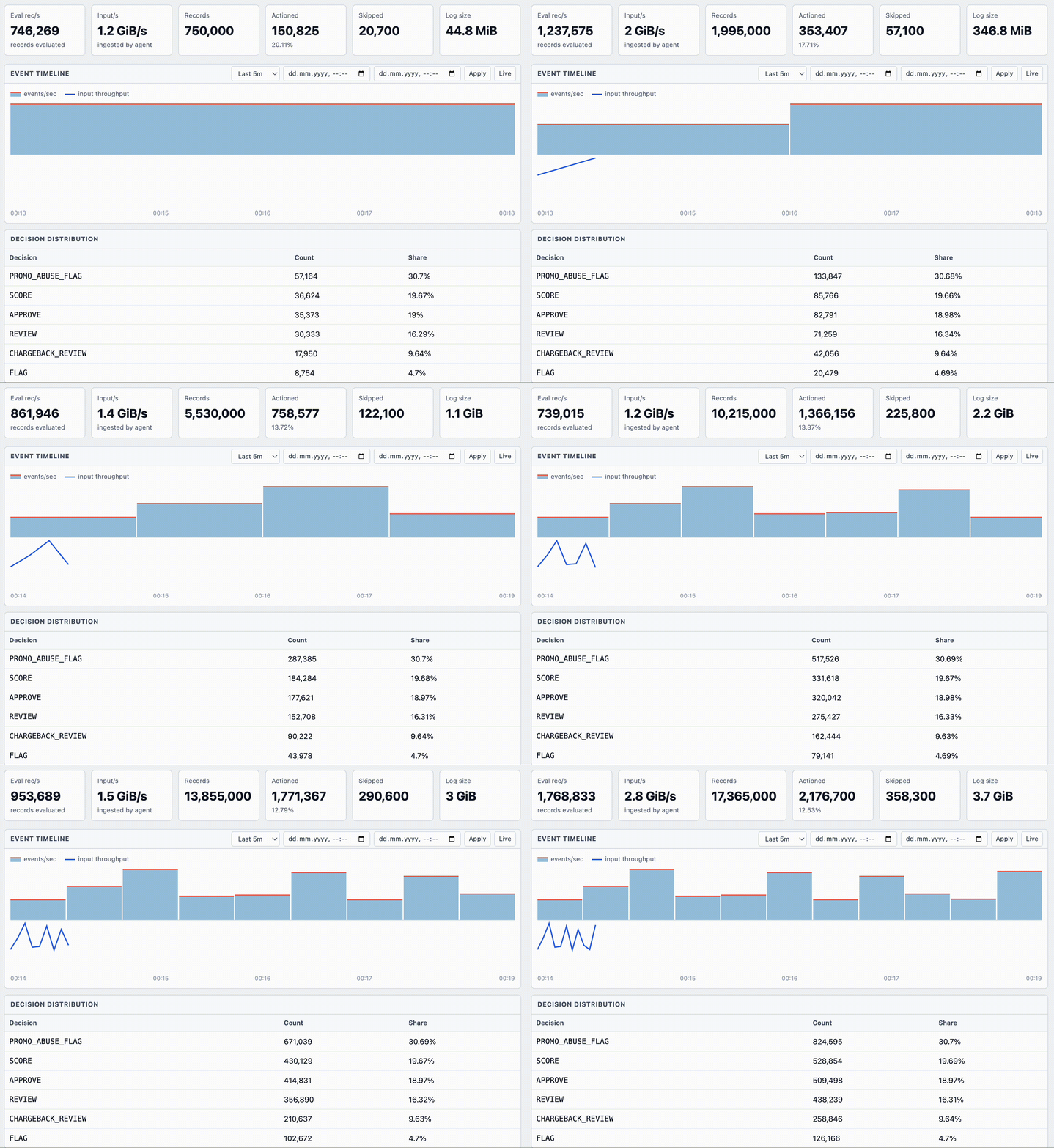
Local Mac Stress Matrix
Benchmarked locally against a large nested rules corpus. Throughput is reported as evaluated events/sec and input GiB/s. Engine-side metrics for comparison
Rules: 1,047
Payloads: nested JSON/Arrow/Avro/Protobuf
Host: local Mac 36GB/12-core
Engine Input Throughput (GiB/s)
JSON Payload Width Sensitivity (GiB/s)
Lower cost starts with fewer raw payloads.
Run decisions before SIEMs, warehouses, queues, and model calls. Routine events become compact decision rows. Records that need review can still keep the full payload.
Full payloads enter every downstream system, whether or not the final decision is simple.
Emit approve, review, block, and DLQ records. Keep raw evidence only for events that need it.
The financial lever is simple: systems that bill by indexed GB, scanned data, or review volume see less input.
A rule engine data plane, not another stream processor or database.
BlazeRules is built for low-latency decision density. Unlike analytical engines or general-purpose stream processors, it optimizes for stateful rule evaluation over batches.
BlazeRules sits between ingestion and persistence, where latency-sensitive decisions are made before storage and workflow systems receive the event.
Capability Landscape
BlazeRules
Designed for fast, columnar rule evaluation over batches with persistent state and rule hot reload. It sits between the high-speed data plane and decision logic.
BRMS / decision suites
Strongest for authoring, governance, business policy modeling, and workflow integration. They are not optimized for raw high-throughput batch evaluation.
Stream processors
Best for distributed streaming, partitioned state, and event-time processing. They excel at large-scale stateful pipelines, not just single-node rule evaluation.
OLAP / SQL engines
Best for analytical queries, ad hoc reporting, joins, and broad SQL workloads where planner-powered query execution is the priority.
Ready for a benchmark?
Run the benchmark harness against your current stack and compare throughput, latency, and payload sensitivity in your own environment.